
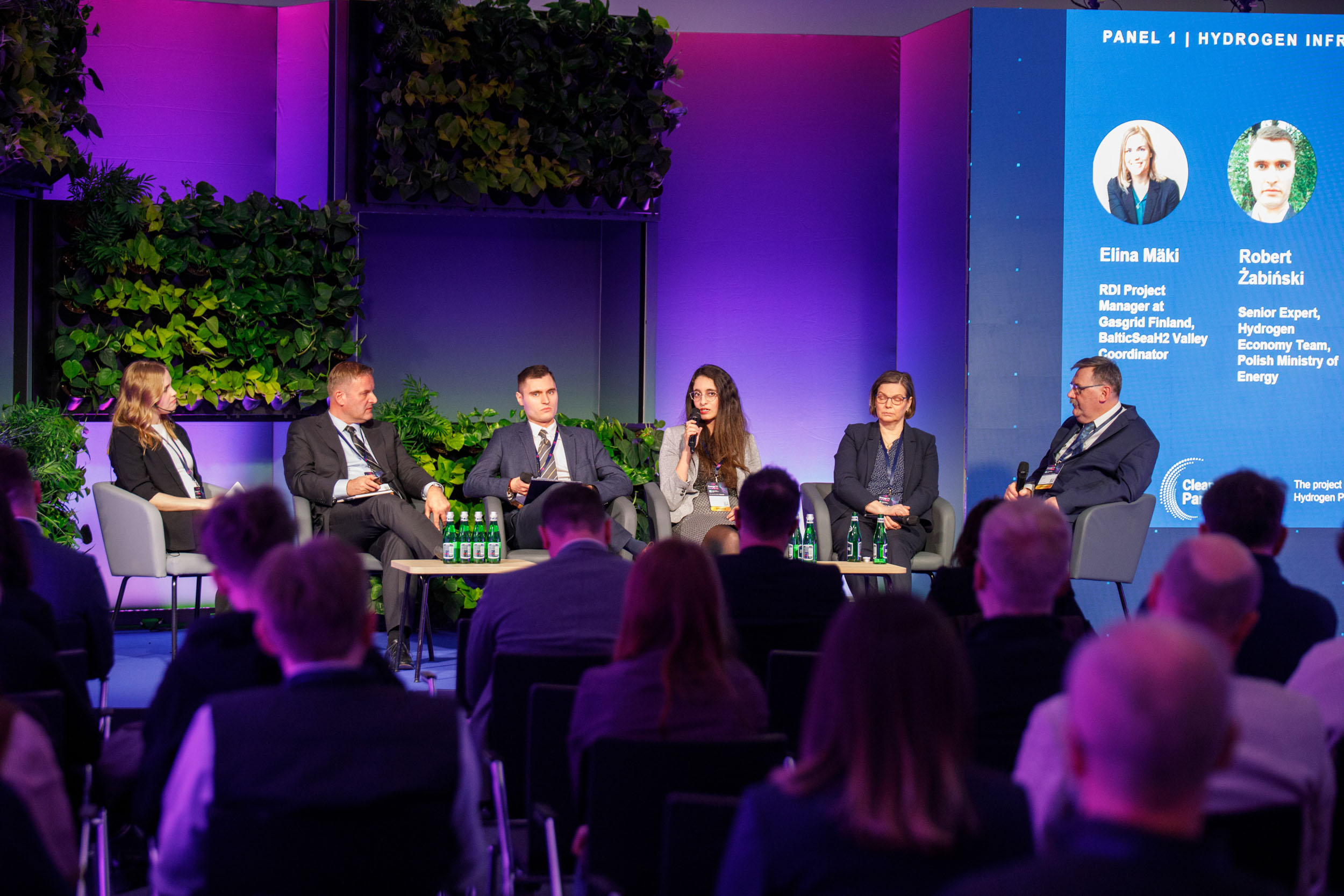
The discussions focused on the practical conditions needed to build an integrated hydrogen economy: cross-border infrastructure, large-scale storage, cities and ports, hydrogen derivatives, market mechanisms and cooperation between countries. Across the sessions, one message was clear: hydrogen deployment depends on much more than individual technologies. It requires aligned infrastructure planning, market demand, regulation, investment conditions and cooperation across the full value chain.
Infrastructure as the backbone of the hydrogen economy
Hydrogen infrastructure was highlighted as a key enabler for the Baltic Sea region. Transmission pipelines and large-scale storage can support not only hydrogen producers and consumers, but also regional energy security, societal resilience and long-term industrial competitiveness.
A central example was the Nordic-Baltic Hydrogen Corridor, a planned cross-border infrastructure project connecting Finland, Estonia, Latvia, Lithuania, Poland and Germany through a hydrogen pipeline system of around 2,500 kilometres. The corridor illustrates how infrastructure can link Finland’s strong renewable hydrogen production potential with growing industrial demand in Poland and Central Europe.
The discussion also underlined the need for early harmonisation of technical standards, regulation and market rules. If hydrogen is to move efficiently across borders, infrastructure cannot be developed only as a set of national projects. It must function as an integrated regional system from the start.
Cities, ports and derivatives create demand-side pathways
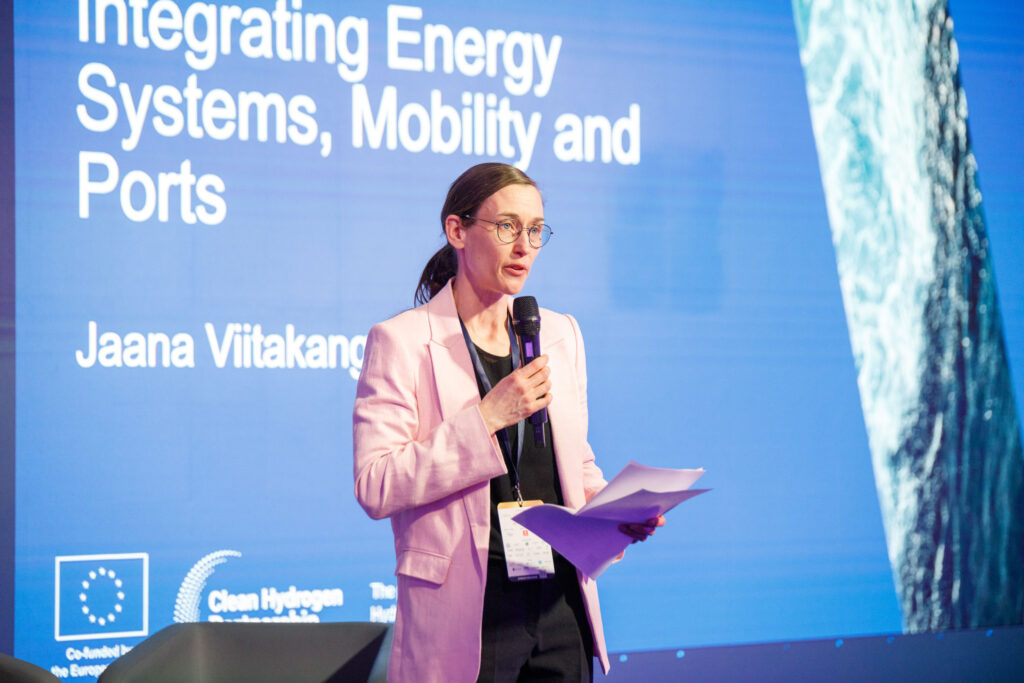
Several sessions looked at how hydrogen can be used in practice across urban energy systems, mobility, ports and industry. Cities and regions were seen as important environments for linking power, heat, transport and industrial demand.
Examples from hydrogen buses, port ecosystems and regional e-fuel production showed that deployment is already becoming more concrete. Ports in particular were discussed as future energy hubs, connecting renewable electricity, hydrogen and derivatives with maritime logistics and industrial users.
Hydrogen derivatives such as ammonia, methanol, synthetic methane and eSAF were also highlighted as important carriers for moving hydrogen into sectors where direct hydrogen use is difficult. For the Baltic Sea region, this creates an opportunity to connect local hydrogen valleys with wider logistics chains and industrial value networks.
From first contracts to a functioning hydrogen market
Market development was another key theme. The hydrogen economy is still largely based on early bilateral agreements, long-term contracts and public support mechanisms. Over time, however, the market will need to become more transparent, scalable and liquid.
The BalticSeaH2 H2Pool concept was discussed as one tool to support this transition. By connecting verified buyers and sellers, digital platforms can improve market visibility, support structured transactions and help develop common product definitions.
At the same time, the discussions made clear that markets cannot develop separately from infrastructure and project deployment. Investors need demand visibility and reduced risk, while buyers need reliable supply, infrastructure access and credible sustainability certification.
Regional cooperation moves from plans to concrete action
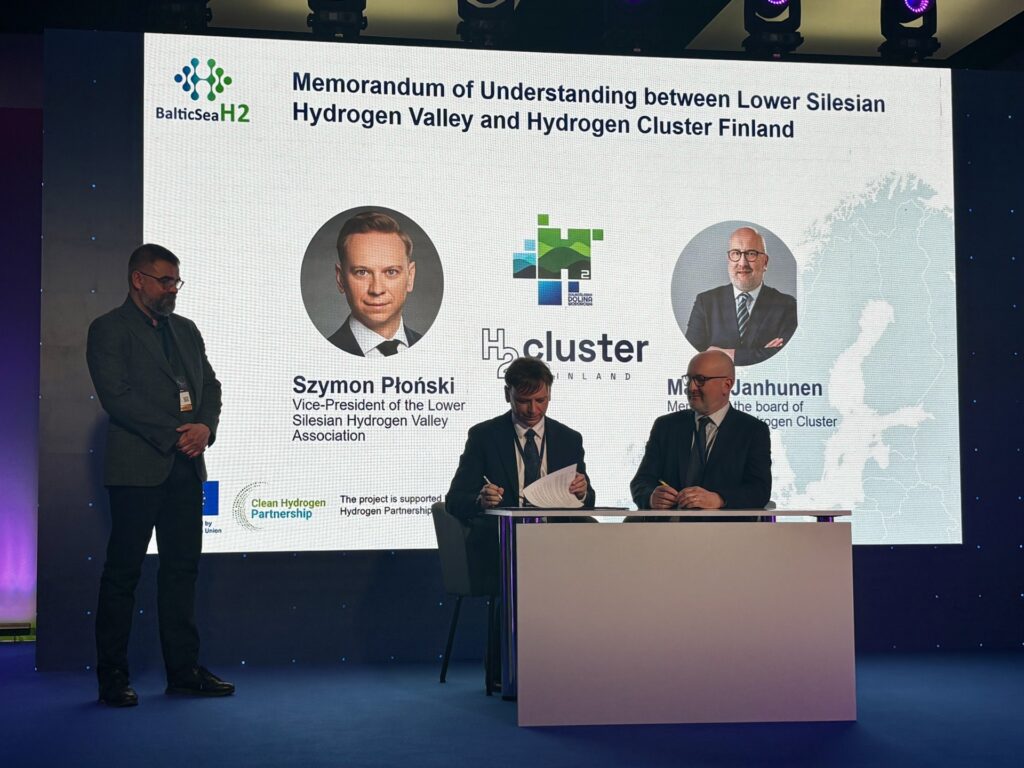
During H2Poland, Hydrogen Cluster Finland and Poland’s Lower Silesian Hydrogen Valley formalised their cooperation through a Memorandum of Understanding. The agreement reflects the complementary roles of Finland and Poland in the emerging hydrogen economy: Finland has strong potential for renewable and low-carbon hydrogen and derivatives production, while Poland brings industrial demand, technical expertise and storage potential.
For BalticSeaH2, this type of cooperation is central. The project brings together partners across the Baltic Sea region to develop the foundations of an integrated hydrogen market. This requires not only technical development, but also stronger links between ecosystems, industries, infrastructure planners and public actors.
The sessions at H2Poland reinforced BalticSeaH2’s core message: hydrogen valleys are not isolated pilot projects. They are system-level environments where infrastructure, production, demand, regulation and investment conditions can be brought together. This is what is needed to move hydrogen from demonstration to deployment and to build a more resilient and competitive energy system for Europe.